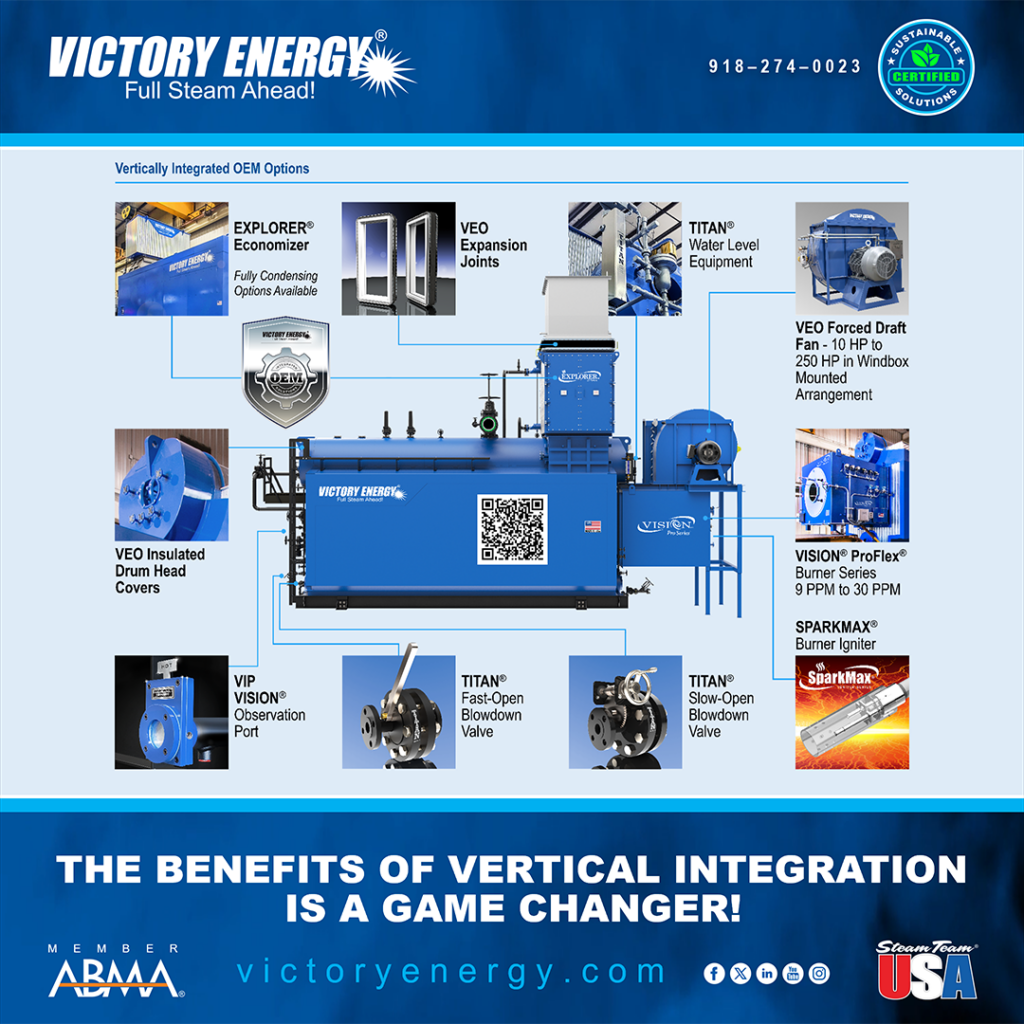
Vertical integration is a key strategic advantage for Victory Energy, as it allows our company to control multiple stages of the production and supply chain for industrial boilers and peripherals. Below are some of the benefits our customers receive through Victory Energy’s vertical integration business model:
Cost Control and Efficiency: By owning or controlling raw material sourcing, manufacturing, assembly, and even distribution, Victory Energy can reduce costs associated with middlemen, negotiate better supplier terms, and optimize production processes. For example, producing boiler components in-house minimizes reliance on external vendors, lowering procurement costs and mitigating price volatility for materials like steel or specialized alloys.
Quality Assurance: Vertical integration ensures consistent quality across all stages of production. Since industrial boilers require precision engineering for safety and performance, controlling component manufacturing and assembly allows Victory Energy to enforce strict quality standards, reducing defects and ensuring compliance with industry regulations (e.g., ASME standards).
Supply Chain Reliability: Controlling upstream (e.g., raw materials) and downstream (e.g., distribution) processes shields Victory Energy from supply chain disruptions, such as delays or shortages from third-party suppliers. This is critical in the industrial sector, where downtime for clients (e.g., power plants or manufacturing facilities) can be costly. For instance, owning peripheral production ensures availability of critical add-ons like economizers or control systems.
Customization and Innovation: Vertical integration enables Victory Energy to tailor boilers and peripherals to specific customer needs. By managing design, production, and integration, we can quickly adapt to market demands or innovate new features (e.g., energy-efficient or low-emission boilers) without relying on external partners, giving us a competitive edge in industries prioritizing sustainability.
Faster Time-to-Market: Controlling multiple stages of production streamlines coordination and reduces lead times. For Victory Energy, this means faster delivery of boilers and peripherals to clients, which is crucial in industries where project timelines are tight, such as construction or energy infrastructure development.
Strategic Independence: Vertical integration reduces dependence on external partners, giving Victory Energy greater control over its strategic direction. This autonomy is vital in navigating market shifts, such as rising material costs or new environmental regulations, without being constrained by supplier limitations.
In summary, vertical integration positions Victory Energy as a resilient, cost-efficient, and innovative leader in the industrial boiler market, enabling us to deliver high-quality, customized sustainable solutions while maintaining control over costs and supply chain dynamics.
Full Steam Ahead!